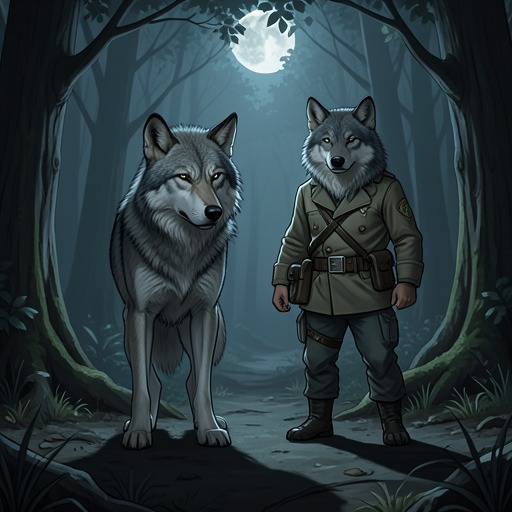
Derek bites Boyd
Holding Out for a Hero ▸ Stiles Stilinski (2)Derek bites Boyd in the course of recruiting him into a new werewolf pack, turning an isolated student into one of the supernatural figures whose presence reshapes the conflict at Beacon Hills High School. The action is decisive because Boyd does not merely become a victim of Derek’s ambition: he accepts the bite as a possible escape from the loneliness that has defined his ordinary life, even while Carson, Scott, and Stiles recognize the danger of that choice.
Causes and Background
Boyd first appears to Carson, Scott, and Stiles as a student who sits alone and keeps his distance from everyone around him. Carson initially interprets his isolation as a personal preference, assuming that Boyd is simply not interested in talking to other people. The discovery that Derek Hale has noticed him changes that interpretation. When Carson sees Boyd’s empty table in the cafeteria, she immediately connects it to Derek’s pattern of pursuing lonely and misunderstood students. She treats the empty seat not as a neutral detail but as a warning sign: Boyd has effectively been marked for recruitment.
The trio confronts Boyd because they fear that Derek will offer him supernatural power without addressing the circumstances that make the offer attractive. Their concern is sharpened by the wider conflict surrounding Scott McCall’s transformation. After Scott is bitten, Carson, Stiles Stilinski, and Scott learn to regard the werewolf bite as a dangerous threshold, one capable of changing a person’s body, senses, relationships, and place in the world. Derek, already an Alpha werewolf, approaches that threshold as a means of assembling a force of his own. For Boyd, however, the prospect is not presented only as an abstract supernatural threat; it arrives against a background of social exclusion.
Carson and Scott try to redirect Boyd by offering ordinary friendship. Carson tells him that he can sit with them and that they would rather have him among friends who understand the supernatural than let him remain with Derek’s group. The offer exposes the emotional cause beneath Boyd’s apparent indifference. He says that he only wants not to eat lunch alone every day. That admission forces Carson and Scott to recognize that Boyd has not freely chosen to be ignored. Rather, other students have ignored him, and he has survived by coping with the resulting hurt. The bite therefore becomes entangled with a basic desire for recognition and belonging.
What Happens at the Ice Rink
The immediate sequence unfolds at the rink, where Carson has arranged for Scott to approach both Erica Reyes and Isaac Lahey. The plan is connected to Boyd’s involvement with the rink and to the effort to keep Derek from drawing more vulnerable students into his brigade. Scott confronts Derek’s newly recruited werewolves, but the encounter quickly becomes uneven. Scott is left bleeding on the floor, while Derek’s experience as a born werewolf and his status as an Alpha give him the advantage.
Derek intervenes after Scott defeats the inexperienced werewolves. The confrontation makes the difference between Scott and Derek visible: Scott is still trying to protect people from the consequences of becoming werewolves, whereas Derek is using recruitment to consolidate a pack. Boyd is present at the point when that struggle becomes personal. He is preparing to leave with Derek, and Scott warns him that he should not want to become like Derek.
Boyd’s reply reveals the crucial reversal in the scene. He exposes the bite on his side and makes clear that he already knows what is happening to him. He does not answer Scott by claiming ignorance or denying Derek’s influence. Instead, he says that he wants to be like Scott. The statement distinguishes Boyd’s aspiration from a simple desire to imitate Derek’s authority. Scott represents, to Boyd, another possible model of being a werewolf: a person who still has friends and a place within a community. Yet the practical result remains the same. Derek has bitten Boyd, and Boyd is carried into the transformation that Scott and his friends had tried to prevent.
Immediate Consequences
Boyd’s bite expands Derek’s werewolf army and increases the pressure on Scott’s already unstable alliance network. Derek now has another recruit drawn from the same social vulnerability that made Erica and Isaac susceptible to his offer. The new werewolves are not merely combatants; each recruitment exposes the ways in which exclusion, fear, and the promise of strength can be converted into pack loyalty.
Scott is left questioning the appeal of the transformation. He asks why anyone would want the life that has brought him danger, violence, and loss. Carson answers that the recruits may believe they are better off this way. Her response does not settle whether the bite is beneficial or destructive. Instead, it identifies the tragic logic of Derek’s recruitment: the offer can seem like salvation to someone whose human life has already become unbearable. Derek’s power lies partly in recognizing that need and presenting the bite as an answer.
For Carson, the scene also produces a moral correction. She had misjudged Boyd by treating his solitude as chosen behavior. His confession about eating lunch alone makes his loneliness legible, and her offer of friendship becomes an attempt to restore a human alternative before the supernatural transformation takes hold. The attempt fails, but its failure matters. Boyd’s decision shows that belonging offered late may not compete with power offered at the moment of greatest vulnerability.
Place in the Supernatural Conflict
The action belongs to the larger struggle between Scott’s protective circle and Derek’s effort to create an independent pack. The first werewolf transformation in the story is associated with heightened senses, strength, speed, and the need to manage the full-moon transformation. Boyd’s recruitment brings those same consequences into the life of a student who has had little social protection. His bite thus links the supernatural rule of transformation to the ordinary social systems of school life: lunch tables, reputation, friendship, and isolation.
That connection also contrasts Derek’s pack with the original trio of Carson, Stiles Stilinski, and Scott. Their friendship predates the supernatural crisis and survives because they repeatedly act for one another rather than demanding obedience. Derek’s recruits, by contrast, are gathered through promises of strength and inclusion, but the relationship is structured by Derek’s Alpha authority. Boyd’s choice demonstrates why the two models can be confused. From outside, Derek’s pack looks like a dangerous brigade; from Boyd’s position, it may look like the first group willing to make room for him.
The event therefore functions as both recruitment and emotional misrecognition. Scott and Carson correctly identify the physical danger of the bite, but they initially struggle to recognize the social injury that makes Boyd accept it. Derek understands the second problem well enough to exploit it. Boyd’s transformation is consequently not only a supernatural escalation; it is a test of whether friendship can answer loneliness before violence and power claim the person suffering from it.
Narrative Significance
Derek bites Boyd at the point where the story’s supernatural rules and its adolescent social world become inseparable. The action creates another werewolf, strengthens Derek’s position, and places a previously overlooked student inside the conflict. More importantly, it complicates the moral language of the bite. The transformation is dangerous, but Boyd’s decision is not irrational within the circumstances the narrative establishes: he wants an identity, a group, and an end to eating lunch alone.
Boyd’s choice also reinforces a recurring contrast between forced secrecy and chosen solidarity. The hunters represented by the Argent family seek to eliminate threats, while Scott’s friends try to prevent harm without abandoning the people caught in the supernatural world. Derek offers a third path, one that turns marginalization into allegiance. The bite leaves Boyd suspended between these models. He has not simply been taken from ordinary life; he has stepped toward a new life because ordinary life has failed to offer him a place.